
 नेपाली

Nepal’s EV Boom Is Growing Fast. But Can the Power Grid Keep Up?
Kathmandu, Nepal’s electric vehicle market is expanding rapidly, but the rise of EVs is creating another challenge that could become increasingly important: Can the country’s electricity infrastructure keep pace with its electric mobility ambitions? Nepal imported 44,535 electric vehicles in fiscal year 2024/25, while registered EVs reached 63,280 by the end of fiscal year 2025/26.
EVs are already adding to electricity demand
According to Sagar Mani Gyawali, chief of the Nepal Electricity Authority’s Charging Station Infrastructure Development Project, EV charging currently consumes around 600,000 units of electricity every day. If that rate remained unchanged for a full year, it would amount to about 219 million units annually—a calculation based on the reported daily figure, not an official annual estimate. EV charging is also estimated to replace around 500,000 litres of petrol and diesel consumption every day.
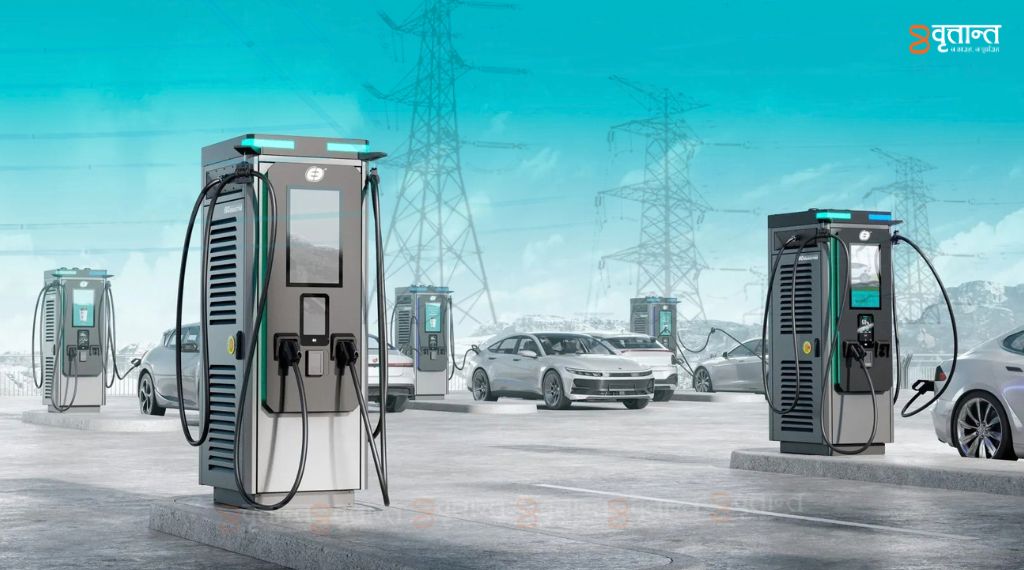
Nepal currently has around 2,500 EV charging stations, with infrastructure expanding beyond major urban centres to areas including Jumla, Manang and Mustang. But the existing network remains far below what may be needed if EV adoption continues to accelerate.
Four times more charging stations
A study by the Ministry of Infrastructure Development has recommended developing at least 10,000 EV charging stations by 2030. Reaching that level from around 2,500 stations would require roughly 7,500 additional stations, effectively quadrupling the network.
The study has also used a planning benchmark of approximately one charging station for every 20 vehicles, implying around 200,000 EVs under that particular planning assumption. That 200,000 figure should not be treated as a confirmed government forecast for 2030; it is derived from the study’s planning ratio.
Nepal has separately set ambitious targets, including 90 percent electric two-wheelers and 60 percent electric private four-wheelers by 2030.
What could 200,000 EVs mean?
The potential electricity requirement can be illustrated using today’s data. Nepal has around 63,280 registered EVs, with reported charging consumption of approximately 600,000 units per day. If average electricity consumption per vehicle remained similar and the fleet reached 200,000 EVs, a proportional calculation would put daily charging demand at roughly 1.9 million units—around 57 million units a month or 693 million units a year.
This is a scenario calculation, not an official forecast. Actual demand could vary significantly depending on vehicle type, annual mileage, battery size, charging efficiency and the share of commercial EVs.
The calculation also reveals why daily electricity consumption alone does not tell the full grid story. The current 600,000 units a day is equivalent to an average load of about 25 MW if spread evenly across 24 hours. At 1.9 million units a day, the average would be about 79 MW. But if a large share of charging happened within six hours, the average load during those hours could reach around 316 MW.
That does not mean EVs will create a simultaneous 316 MW load. It illustrates how concentrated charging can create much greater pressure than the daily energy figure suggests.
Nepal has power. The question is where it can deliver it.
According to Nepal Electricity Authority data, Nepal had 3,591 MW of installed generation capacity in FY2024/25, against national peak demand of 2,409 MW and a total system peak of 2,901 MW. These figures suggest that generation capacity is not currently the most immediate constraint for EV growth, although installed capacity is not the same as continuously available electricity.
The more important question may lie further down the network. Nepal had around 6,760 circuit-km of high-voltage transmission lines and transmission substations with approximately 14,123 MVA of capacity. Its distribution system included around 8,145 circuit-km of 33 kV lines, 53,131 circuit-km of 11 kV lines and 156,790 circuit-km of low-voltage lines. It also had 210 distribution substations with a combined capacity of around 2,997 MVA, along with approximately 48,625 distribution transformers.
These figures describe the size of the network, not the spare capacity available at every location. A national system can have sufficient generation while a particular transformer, feeder or substation becomes heavily loaded when many EVs charge in the same area.
What 10,000 charging stations could mean
The 10,000-station target also does not mean that 10,000 chargers will operate at full power simultaneously. But the potential scale is significant. If every station had a 60-kW charger, their combined installed capacity would be 600 MW. At 100 kW per station, it would be 1,000 MW, and at 150 kW it would reach 1,500 MW.
These are theoretical installed-capacity scenarios, not forecasts of actual peak demand. Real charging stations will have different power ratings and utilisation levels. Still, they demonstrate why charging infrastructure and grid planning cannot be treated as separate issues.
The next bottleneck may be the distribution network
As EV adoption increases, Nepal may need more than additional generation. Larger transformers, additional substations, stronger feeders, upgraded transmission links, better demand forecasting and smart charging systems could become necessary to manage the new load.
Smart charging could help by shifting vehicle charging toward periods when the grid has greater available capacity. Without such management, large numbers of fast chargers operating simultaneously could create local pressure even when the national electricity system has enough overall energy.
Facts are clear. The future is a calculation.
The facts are straightforward: Nepal imported more than 44,000 EVs in one fiscal year, EV charging already consumes around 600,000 units a day, the country has roughly 2,500 charging stations, and a government study recommends 10,000 stations by 2030.
The future numbers are less certain. If Nepal reaches 200,000 EVs and current average charging behaviour remains broadly unchanged, the scenario calculation points to roughly 1.9 million units of charging demand per day. But that is not a forecast. Changes in vehicle efficiency, travel patterns, charging technology and fleet composition could produce a very different outcome.
The real question is therefore not simply whether Nepal has enough electricity. It is whether the country can deliver that electricity to the right place, at the right time and at the required power level.
Nepal’s EV revolution is already accelerating. Now the power grid has to keep up.