
 नेपाली

Published: October 8, 2026
By Britant News, Kathmandu
Artificial intelligence is beginning to reshape South Asia’s labour markets, slowing hiring in some sectors while creating new opportunities for workers and service exporters, according to a new World Bank report.
The South Asia Economic Update: Adopting AI for Growth says AI adoption is increasing across the region, although it remains below levels seen in advanced economies. Its impact is already becoming visible in the business process outsourcing (BPO) and information and communications technology (ICT) sectors, which account for a significant share of South Asia’s service exports.
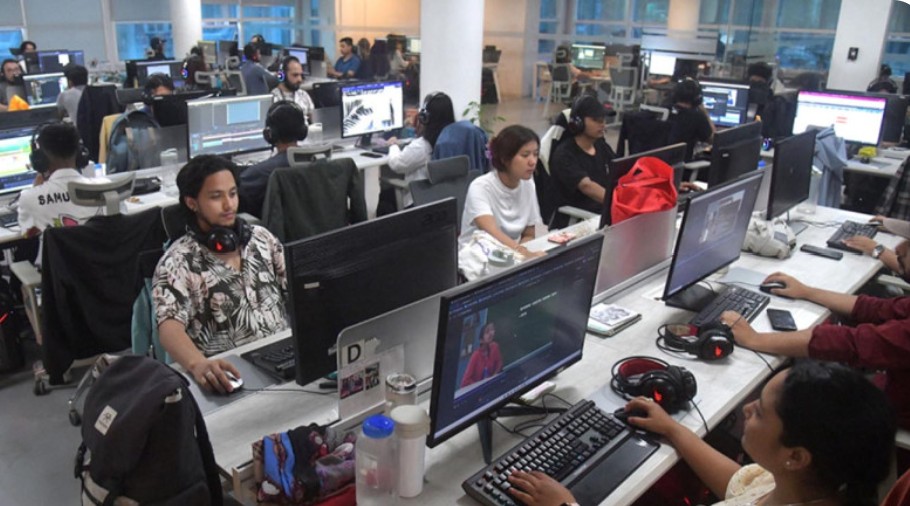
For years, countries including Nepal have provided services such as customer support, data processing, software development, accounting and other business functions to clients in the United States and Europe.
However, the growing use of AI could allow foreign companies to bring some of these functions back in-house, reducing demand for certain lower-value and easily automated services.
The World Bank identifies software development, customer support, accounting, web development and payroll processing among activities that could face greater automation pressure.
AI skills bring new opportunities
Despite the risks, the report says AI is also creating opportunities for South Asian workers and businesses. Demand is rising for workers with AI-related skills, with jobs requiring such skills earning nearly 30 percent higher wages than other white-collar positions, according to the report.
The World Bank estimates that around 15 percent of South Asian workers are in jobs where AI and human labour could strongly complement each other, potentially increasing productivity.
By comparison, about 7 percent of jobs are highly exposed to AI without strong complementarity and face greater automation risks.
The report says South Asia’s overall exposure remains relatively low because a large share of its workforce is engaged in agriculture, manual labour and other low-skilled occupations that are less susceptible to AI-driven automation.
Opportunity for Nepal
For Nepal’s technology sector, experts say the changing labour market highlights the need to develop skills that complement AI rather than compete with it.
Gaurav Raj Pandey, former president of the Nepal Association for Software and IT Services Companies (NAS-IT), said workers will increasingly need skills in using AI tools, validating AI-generated outputs, working with data and applying domain-specific knowledge.
He said falling costs of developing digital systems and processing data could encourage more companies to adopt AI, creating opportunities for Nepal to expand its IT and digital-service exports.
The World Bank’s chief economist for Asia, Franziska Ohnsorge, said AI could boost labour productivity, expand export opportunities and improve public service delivery across South Asia.
However, she stressed that governments need to address basic infrastructure and other gaps that could limit the region’s ability to benefit from AI.
For Nepal, the message is increasingly clear, AI may eliminate some routine work, but workers and companies equipped to use AI could gain access to higher-value global opportunities.
Source: The Kathmandu Post