
 नेपाली

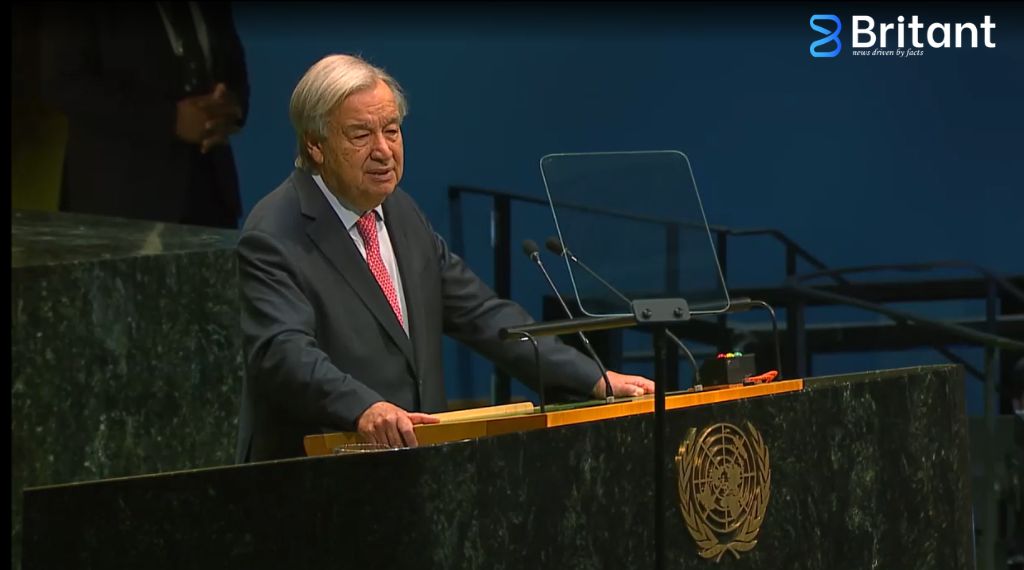
Kathmandu, UN Secretary-General António Guterres delivered a wide-ranging address opening the General Assembly’s 81st session on Tuesday, framing the world’s biggest crises — war, inequality, climate change, and artificial intelligence — as different expressions of a single underlying struggle over how power is exercised and by whom, in what was confirmed as his final General Assembly speech before his term ends in roughly 100 days.
Guterres argued that international norms have eroded over the past decade, with civilians and humanitarian workers increasingly targeted in conflict and trust between nations fraying. He described power itself as being reshaped in three ways: the rise of new state powers, a significant shift of authority from governments to private corporations and individuals, and the growing role of AI and autonomous systems in decisions once reserved for humans. He said the world’s divisions have deepened to the point that “cracks have become canyons,” and called for renewed global cooperation rather than a slide into rival blocs — a scenario he has previously termed the “Great Fracture.”
On conflict, Guterres pointed to the Middle East, Ukraine, Sudan and Myanmar, arguing that so-called ceasefires have often amounted to little more than reduced fighting, with civilians still bearing the cost. He renewed calls for compliance with International Court of Justice orders on Gaza, warned that settlement expansion in the occupied West Bank threatens the two-state solution, and again condemned Russia’s invasion of Ukraine as a violation of the UN Charter. He also repeated long-standing calls for UN Security Council reform, calling the continued absence of permanent African representation unjust given how much the geopolitical landscape has shifted since the council was founded.
On inequality, Guterres argued that record global wealth exists alongside billions still lacking food, clean water, education and healthcare, and said the international financial system leaves developing nations burdened by debt while facing climate disasters they had little role in causing. He called for faster debt relief, stronger multilateral development banks, and fairer access to the IMF’s Special Drawing Rights. He also announced that the UN has achieved full gender parity across its senior leadership and staff for the first time in its history, calling equality “a decision,” not merely an aspiration.
It was on climate change that Guterres brought his message back to Nepal. He described the climate crisis as the most severe imbalance of power between today’s generation and generations yet to come, warning that breaching the 1.5°C global temperature threshold now looks all but certain. He called on major polluters to help cover the cost of the damage and urged wealthy nations to triple climate adaptation funding, contrasting the scale of oil company profits since Russia’s invasion of Ukraine with the far smaller sums currently available to developing nations for adaptation. As in earlier remarks tied to Nepal’s recent disasters, he argued that vulnerable countries are paying the heaviest price for a crisis they did little to cause, while still not receiving the support or justice they are owed.
On artificial intelligence, Guterres warned that power is increasingly concentrated in data, computing capacity, and algorithms, advancing faster than the world’s ability to govern it. He said the real danger is not the technology itself, but its use without accountability, and called for a multilateral framework to manage AI risk, including independent oversight. He was direct in warning against removing humans from life-and-death decisions, arguing that autonomous weapons systems have no place in the world’s future, and that children must not become test subjects for unregulated technology.
Closing his address, Guterres tied the UN’s founding, more than 80 years ago in the aftermath of World War II, to the same idea underpinning his speech: that shared futures require shared rules. He pledged to continue championing the UN Charter’s values through the remainder of his term and beyond, arguing that the world needs a stronger UN, not a weaker one, to meet current challenges.